

Authorial Intrusions
On synchronicity, grief, and the suspicion that we're inside a story


If you’ve listened to more than like three episodes of GGU, you’ve heard us ask you to send your stories. And a lot of you have!
Including a listener named Brendan, who sent us an experience that knocked us over. He wrote it with such eloquence, and such earnest searching, that we had to ask if we could share it.
He graciously agreed.
Brendan is a former strict materialist who has been rethinking some fundamental assumptions about how reality works. The story he shares is a meditation on grief, on beauty, and what it feels like to suspect that the universe is authored. He somehow draws together a teenager’s roadside memorial, a Nabokov pun, and Beethoven’s Ninth, without once reaching for easy or satisfying conclusions.
We also asked Brendan if he’d be willing to get on the mic with us to talk more about these things, and he said yes. We’ll be recording a bonus episode with him on Monday — which will only be available to paid subscribers here and on Patreon.
What follows is what he sent us, lightly edited for publication, with his permission.
The Face of a Loved One
At the end of Episode 40, Mal said, “We want to hear your synchronicities.” I felt moved to share one. But I should preface it with a warning that it involves the death of young people.
Last year, I moved to a new apartment in a new city. It was a transitional period in my life, a temporary refuge after a series of painful events. I planned to live there for a year while I healed.
My new place was on the corner of a busy intersection. One morning I heard an unusual noise and stepped outside. There was an awful silence over the intersection, and bodies lay in the road. It was easy to see what had happened. An electric scooter had collided with a pickup truck. The victims were the two teenage boys on the scooter. I called 911. A small crowd had begun to gather. One of the boys would survive. One would not.
I didn’t know the boy who died, but one of the events that had led me to seek refuge in this new city was the death of another teenager - someone I did know, whose family I knew very well. Witnessing a deadly accident would have been traumatizing anyway. Being so physically close to this second tragedy after having been so emotionally close to another left me reeling.
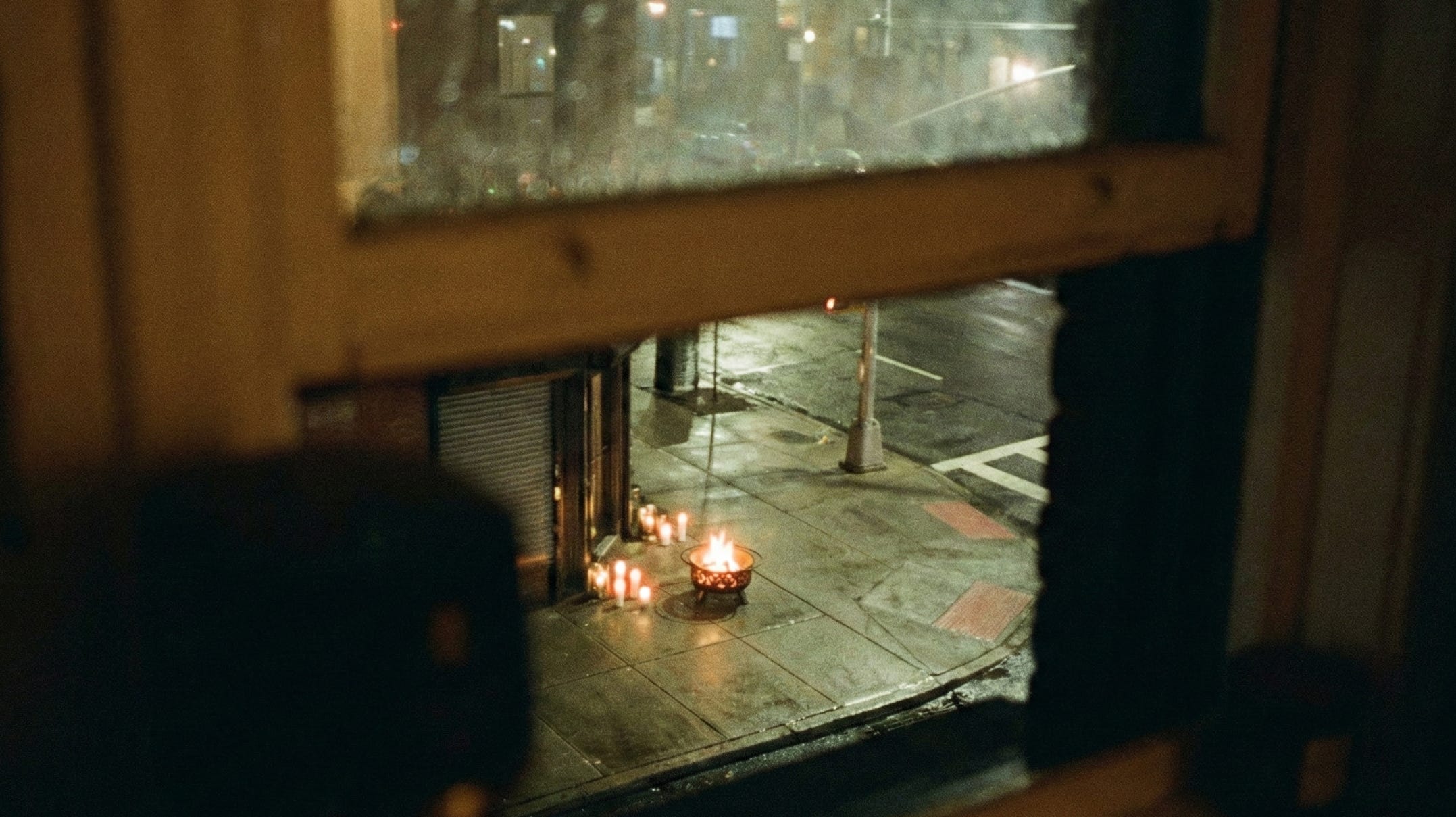
Two nights later, the bereaved family gathered on the corner to hold an improvised memorial service. From my kitchen window, as I ate dinner, I watched as they lit candles and set off fireworks. At the end they huddled together and yelled, “We love you, [K-something],” over and over, but I couldn’t make out the name in that chorus of voices, inartfully harmonized in profound grief. I broke down bawling. I cried harder than I ever had for the family I knew and loved, where the pain had seemed too huge to ever come out in tears. I was crying for the boy who died, for his family, for the young man I had known and his family, and for the other losses that were wrapped up in the part of my life that I was trying to heal from.
On that night, so soon after the accident, the name I hadn’t been able to hear had not yet been made public. But when the tears passed, I realized how much it troubled me that I had been present for the last moments of this boy’s life and didn’t know his name.
The next morning I saw notes from his family on the lamppost. That’s how I learned that the boy had been called Kevin. “Ok,” I thought to myself. “His name was Kevin. What you heard was, ‘We love you, Kevin.’” Knowing the name, knowing how to properly terminate those shouts that were still reverberating through my head, helped ground me in the love that I’d heard expressed.
Then, because life goes on, I walked back across the street and immediately jumped on a work call. At the start of the call, my boss mentioned that she needed to run through a list of employees and mark them “yes” or “no.”
“Jerome,” she began. “No. Carlos, no. Jermaine, maybe. Mark, no. Kevin, we love you, Kevin, but no. Brianna, yes. Andrew, no…” She continued on down the list, and I stood in front of my computer, silent and astonished.
I can’t tell you what that moment meant. That echo. I can tell you that it wasn’t a coincidence, and that when something like that happens, or manifests, you’re no more likely to mistake it for a coincidence than you are to mistake the face of a loved one for the face of a stranger. It may prompt confusion, but it does not leave room for doubt.
Having said that, though - this synchronicity happened to me at a time when I was emotionally raw, and also undergoing a pretty serious change of worldview. I was at least partly open to it. I wonder how many times I haven’t been open to such things - how many times, in my close-mindedness or my self-absorption or my insecurity, I did mistake the face of a loved one for a stranger. Writing this has helped me realize how badly I want that never to happen again.
Symphony
In the Nabokov novel Pale Fire, there’s a scene in which a farmer, a minor character, is out for a walk with his young son, an even more minor character, and a neighbor. When they come to a certain spot in the path, the son turns to the neighbor and announces, “Here Papa pisses.”
On the surface, the remark is a throwaway line,

 | A guest post by
|